
The Future of Agents: Leaving Chatbots Behind
The Future of Agents: Leaving Chatbots Behind
Since the explosive launch of ChatGPT, the tech industry has been obsessed with "chatbots." Companies raced to stick conversational interfaces on top of their documentation, resulting in systems that could answer questions but ultimately lacked the ability to actually do work.
We are currently undergoing a paradigm shift from conversational AI to agentic AI. In the next 12 months, the most valuable applications will not be those that answer you, but those that accomplish tasks for you while you sleep.
What is an AI Agent?
An AI Agent is a Large Language Model equipped with three distinct capabilities that a standard chatbot lacks:
- Memory: The ability to permanently store past interactions, user preferences, and global state in a Vector Database (like Pinecone) or a graph database (like Neo4j) to maintain long-term context across sessions.
- Planning: The ability to use frameworks like ReAct (Reasoning and Acting) to break a massive objective ("Migrate this codebase from React to Vue") into a 40-step sequential plan, evaluating the success of each step before proceeding to the next.
- Tools (Actuators): The ability to execute physical functions. Instead of outputting text, the agent outputs a JSON payload that triggers an API, executes a Python script in a sandbox, spins up an AWS EC2 instance, or sends an email.
The Multi-Agent Architecture
When humans tackle complex enterprise problems, they don't rely on a single hyper-intelligent genius to do everything; they build a structured company with specialists. Agentic architecture follows this exact blueprint.
Using frameworks like CrewAI or AutoGen, developers are now building multi-agent swarms:
- The Architect Agent: Analyzes a Jira ticket and writes the technical specification.
- The Senior Developer: Reads the specification and writes the Python code, utilizing a tool to search StackOverflow for updated libraries.
- The QA Agent: Receives the code from the developer and runs an automated test suite. If it fails, the QA agent sends the error logs back to the Senior Developer with instructions on how to fix it.
This internal dialogue happens entirely autonomously in the background, consuming API tokens instead of human hours.
The Economic Impact
The implications of Agentic AI are staggering. Software margins are already heavily decoupled from the cost of physical goods, but they remain tied to human labor costs. When Junior Developer tasks, initial QA testing, and Level 1 Customer Support are fully handled by autonomous agents running at $0.05 per task, the definition of a "tech startup" radically changes.
Expect to see billion-dollar valuations achieved by companies with fewer than 5 human employees. The question is no longer "What can AI say?", but "What can AI build?"
Related Reading
Event-Driven Architecture for Agentic AI: The Architect's Guide
A comprehensive architectural guide to designing resilient, real-time agentic AI systems using event-driven architecture — covering loose coupling, fault isolation, reference architecture, and governance patterns.
OpenClaw Alternatives: Hermes, NanoBot, ZeroClaw, and PicoClaw Compared
A practical comparison of four OpenClaw alternatives for autonomous workflows, lightweight automation, persistent assistants, and low-resource deployments.
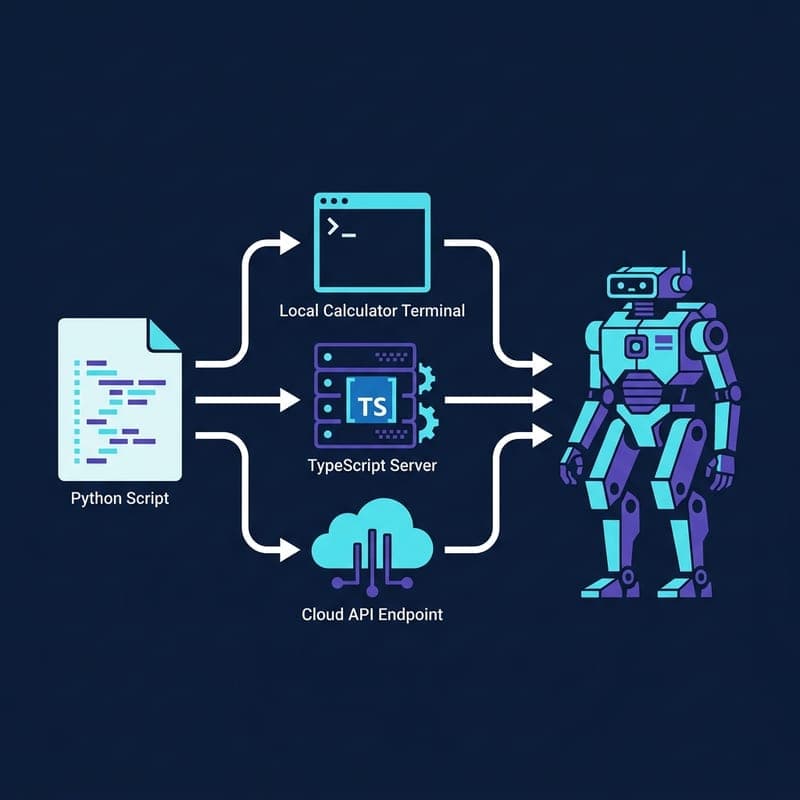
Build a Multi-Tool Claude Agent with MCP Servers in Python
Wire Claude to a local calculator, Brave search MCP server, and Anthropic-hosted tools in one extensible Python agent loop.