
OpenClaw Alternatives: Hermes, NanoBot, ZeroClaw, and PicoClaw Compared
In this article
OpenClaw Alternatives: Choosing the Right Autonomous Agent Stack
OpenClaw has become a recognizable option for people who want an always-on AI assistant that can connect to real tools, run workflows, respond across messaging channels, and automate multi-step tasks. It is powerful, but it is not always the simplest fit.
Some users want a lighter agent that runs on a small server. Others want a persistent assistant with long-term context. Some only need a narrow automation loop for APIs, customer support, or coding tasks. The best choice depends less on which project has the biggest feature list and more on what kind of work the agent needs to handle.
Below is a practical look at four OpenClaw alternatives: Hermes Agent, NanoBot, ZeroClaw, and PicoClaw.
Quick Comparison
| Tool | Best For | Multi-Agent Support | Browser Automation | Main Strength |
|---|---|---|---|---|
| OpenClaw | Complex workflows across systems and channels | Yes | Yes | Broad orchestration and tool access |
| Hermes Agent | Persistent assistants with ongoing context | Yes | Yes | Long-running personal or system-level assistance |
| NanoBot | Small, well-defined task automation | No | Limited, often through tool integrations | Simple Python-based agent workflows |
| ZeroClaw | Lightweight automation on modest hardware | No | Yes | Low-overhead persistent automation |
| PicoClaw | Very constrained local or embedded environments | No | No | Minimal resource usage and local execution |
Why Look Beyond OpenClaw?
OpenClaw is designed for serious automation. Its architecture typically includes a runtime, gateway layer, skills, messaging integrations, file access, scheduling, and tool execution. That makes it useful for home-lab operations, support workflows, and multi-channel automation.
The tradeoff is complexity. Setting it up properly takes technical confidence. Users need to understand configuration, permissions, skills, runtime behavior, and the security implications of giving an AI agent access to local tools or external services.
For some projects, that power is exactly the point. For others, it is too much machinery. If the goal is simply to run a few API-based actions, host a lightweight assistant, or deploy an agent on a small device, a narrower framework may be easier to maintain.
1. Hermes Agent
Hermes Agent is one of the closest alternatives to OpenClaw because it is also aimed at long-running assistant behavior rather than one-off prompt execution. It is commonly positioned as a persistent agent that can operate from a terminal, server, or connected environment.
The biggest appeal of Hermes is continuity. Instead of treating each task as a disconnected session, Hermes is designed around the idea of an assistant that can keep operating over time, remember prior interactions, and improve its behavior through repeated use.
Hermes is a good fit if you want:
- A long-running AI assistant
- Context that carries across sessions
- Tool use from a server or terminal environment
- A system that feels closer to a persistent digital operator than a simple script
Compared with OpenClaw, Hermes is less about coordinating a wide mesh of channels, skills, and task runners. It is better understood as a persistent assistant framework for people who want continuity and adaptation more than broad workflow orchestration.
2. NanoBot
NanoBot is a lighter agent framework, usually attractive to developers who want a simple Python-based loop for connecting language models to tools.
Its strength is focus. NanoBot is not trying to become a full personal operating layer. It is better suited for defined jobs such as calling APIs, routing support requests, assisting with coding tasks, or automating a narrow SaaS workflow.
NanoBot is a good fit if you want:
- A small agent with a clear task boundary
- Python-first customization
- API-based workflows
- Tool calling without a large orchestration system
- Simpler deployment and maintenance
The main limitation is that NanoBot is not built around deep desktop control, operating-system automation, or multi-agent coordination. If your automation needs multiple specialized agents working together across messaging, files, browsers, and scheduled background tasks, OpenClaw remains the broader system.
But if you only need one agent to complete one well-defined workflow, NanoBot may be the cleaner option.
3. ZeroClaw
ZeroClaw is aimed at users who want an autonomous assistant without heavy infrastructure. It is designed for smaller environments such as lightweight VPS instances, old laptops, or single-board computers.
The key idea is low overhead. Instead of trying to support every advanced orchestration pattern, ZeroClaw focuses on staying efficient, persistent, and relatively easy to extend.
ZeroClaw is a good fit if you want:
- A lightweight assistant on limited hardware
- Simple persistent automation
- CLI or chat-based interaction
- Basic memory and tool execution
- Lower operational complexity than a larger agent stack
Its execution model is usually more linear: observe the task, form a plan, act, evaluate the result, then update state. That is enough for many personal automation jobs, especially when the workflows are predictable.
The tradeoff is reduced flexibility. ZeroClaw is not ideal for large multi-agent systems or complex cross-platform coordination. It shines when the automation should stay small, reliable, and inexpensive to run.
4. PicoClaw
PicoClaw goes even further toward minimalism. It is designed for very small or constrained environments where CPU, memory, and network access may be limited.
This makes it a different kind of OpenClaw alternative. It is not meant to replace a full agent platform for browser control, desktop workflows, or multi-channel operations. Instead, it is useful when the priority is local execution, privacy, and low resource consumption.
PicoClaw is a good fit if you want:
- AI assistance on low-power hardware
- Local-first or privacy-sensitive deployments
- Simple command execution
- Small tool calls rather than complex workflows
- Fast startup and minimal system requirements
PicoClaw is especially relevant for edge devices, embedded experiments, or local assistants that should avoid sending unnecessary data elsewhere. Its limitation is obvious: it does not aim to handle browser automation or full desktop-style control.
Autonomous Agents vs AI Assistants
It helps to separate two ideas that are often mixed together.
An AI assistant usually responds when the user asks for help. It may summarize, answer questions, draft messages, or suggest next steps. The user still drives the process.
An autonomous agent can continue a workflow after the initial instruction. It can call tools, run scripts, check results, and make follow-up decisions without needing a human prompt at every step.
OpenClaw sits firmly in the autonomous agent category. So do some of its alternatives, but with different levels of independence and scope. Hermes leans toward persistent assistance. NanoBot focuses on narrow tool-driven jobs. ZeroClaw keeps automation lightweight. PicoClaw targets constrained local environments.
How to Choose
Choose OpenClaw if you need broad orchestration across multiple systems, messaging channels, scheduled tasks, files, browser automation, and custom skills.
Choose Hermes Agent if you want a persistent assistant that can keep context over time and operate as a long-running service.
Choose NanoBot if your use case is narrow, API-heavy, and easier to express as a Python tool-calling workflow.
Choose ZeroClaw if you want a lightweight always-on assistant that can run on modest hardware without a complex setup.
Choose PicoClaw if your priority is minimal resource usage, local execution, and simple automation on constrained devices.
Bottom Line
There is no single best OpenClaw alternative. The right tool depends on how much autonomy, hardware efficiency, and orchestration you need.
For complex home-lab or enterprise-style automation, OpenClaw remains the most capable option. For persistent personal assistance, Hermes is compelling. For small task automation, NanoBot is easier to reason about. For low-resource servers, ZeroClaw is practical. For embedded or local-first environments, PicoClaw keeps things lean.
The smartest approach is to start with the smallest framework that can safely complete the workflow. Add complexity only when the task genuinely requires it.
Related Reading
Cloudflare Cuts Astro GitHub Issues 85% with Decomposed AI Agents
Cloudflare's agentic triage pipeline cut Astro's open GitHub issues from 200+ to ~30. Here's the exact architecture behind that 85% reduction.
The Future of Agents: Leaving Chatbots Behind
We are moving from conversational AI to agentic AI. Explore how autonomous swarms are changing software development.
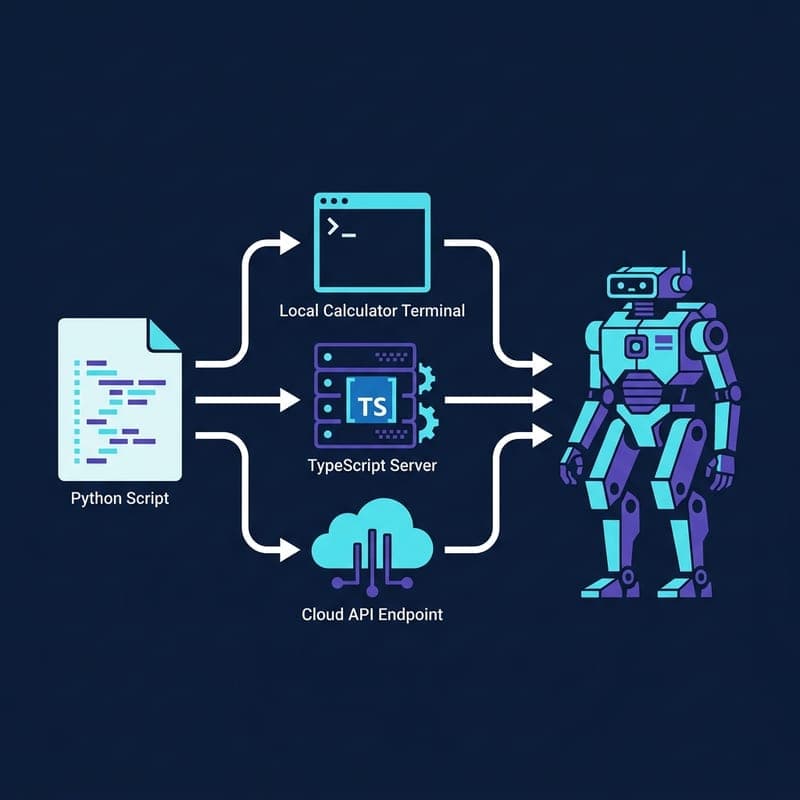
Build a Multi-Tool Claude Agent with MCP Servers in Python
Wire Claude to a local calculator, Brave search MCP server, and Anthropic-hosted tools in one extensible Python agent loop.