
Why Vector Databases are Essential for Enterprise AI
In this article
Unlocking RAG: The Power of Vector Databases
When enterprises begin integrating Generative AI into their internal workflows, they immediately hit a wall: Large Language Models (LLMs) don't know the company's proprietary data. You can't ask ChatGPT for your internal Q3 financial projections because it wasn't trained on them.
The industry standard solution for this is Retrieval-Augmented Generation (RAG). And the beating heart of any robust RAG pipeline is the Vector Database.
The Limitations of Traditional Search
Ask yourself how a traditional SQL database or keyword-based search engine (like Elasticsearch) works. If you search for the word "canine", the database looks for exact string matches of the letters c-a-n-i-n-e. It will completely miss a document that talks extensively about "dogs" or "puppies" because it lacks the ability to understand semantic meaning.
When dealing with AI, we need systems that understand concepts, not just letters.
Enter 'Embeddings'
An embedding model takes a chunk of text (or an image) and mathematically translates its underlying semantic meaning into a highly dimensional array of numbers (a vector). For example, a vector might have 1,536 dimensions.
In this mathematical vector space, the coordinates for the word "King" minus "Man" plus "Woman" result in coordinates that are incredibly close to the word "Queen." The AI literally charts meaning geometrically.
What is a Vector Database?
A Vector Database (such as Pinecone, Milvus, or Qdrant) is uniquely designed to store these massive arrays of numbers. More importantly, they are optimized to perform Similarity Search.
When a user asks your company's AI chatbot a question:
- The question is converted into a vector.
- The Vector Database rapidly calculates the distance between the question's vector and the millions of document vectors stored inside it.
- It returns the top 5 documents that are nearest in contextual meaning—even if they don't share a single exact keyword.
- The application feeds those relevant documents to the LLM to generate an accurate, grounded answer.
Building the Future
If you want to build AI agents that actually understand context, you must move beyond SQL. Vector databases bridge the gap between static enterprise data and dynamic AI reasoning, eliminating hallucinations and ensuring your models always have the right facts on hand.
Related Reading
Sentence Transformers v6.0 Adds ColBERT Training in 14.5 Hours on One GPU
Sentence Transformers v6.0 adds MultiVectorEncoder with full ColBERT-style training. A single RTX 3090 run beats every zero-shot retriever by 0.06 NDCG@10.
Beyond Prompt Engineering: Deep-Dive RAG for Intent Detection & Slot Filling in AI Agents
Stop relying on massive, static context prompts. Learn how to combine Retrieval-Augmented Generation (RAG), vector search (FAISS), and history compaction to achieve scalable intent detection and slot filling.
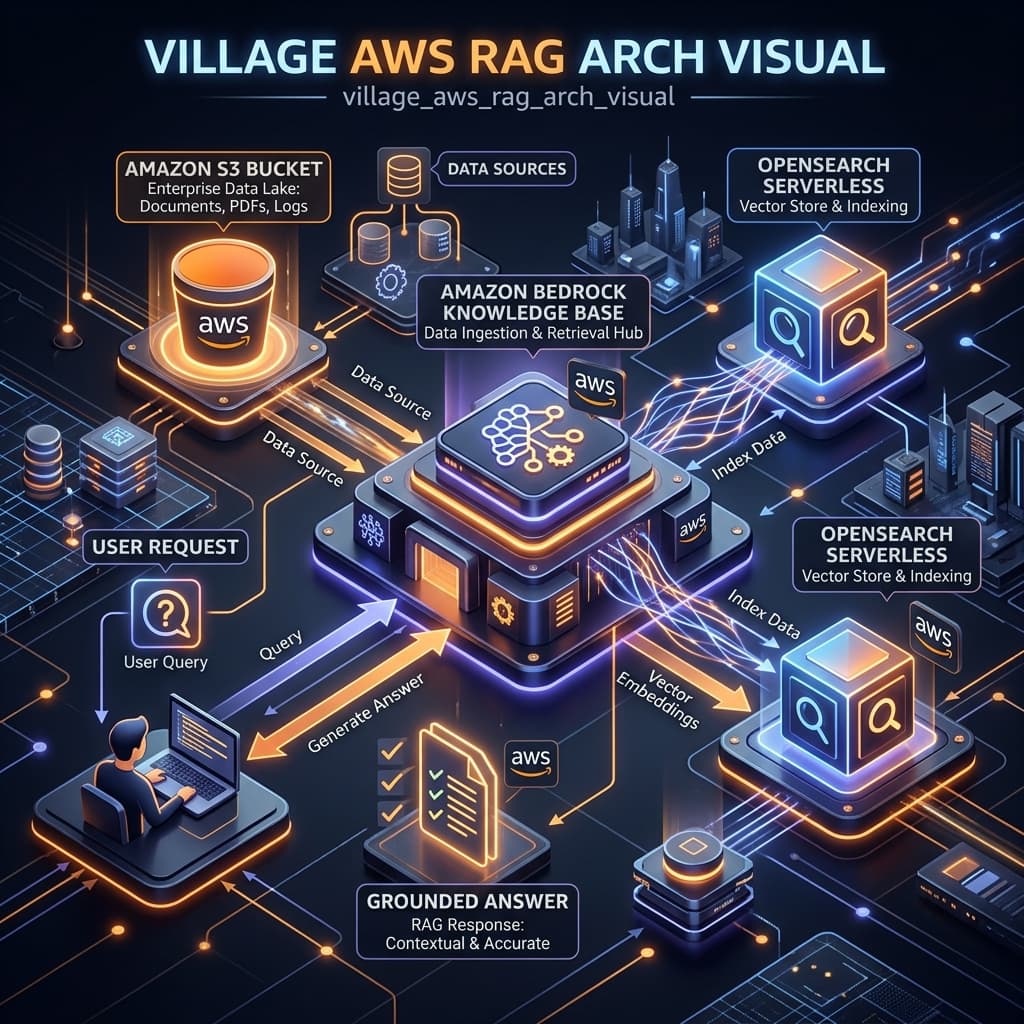
Building a Production RAG Pipeline with Bedrock and OpenSearch Serverless
Everyone has shipped a RAG demo. Shipping one that survives real traffic, security audits, and finance reviews requires a different architecture. Explore the enterprise-grade RAG stack on AWS.