
Google DeepMind SL2T: Sign Language to Text at Consumer Scale
In this article
Google DeepMind shipped SL2T — its sign-language-to-text translation model — on August 12, 2026, making it the first sign language AI the lab has pushed into consumer products. The model powers sign-to-text dictation inside Gboard and Live Transcribe on Pixel 11, starting with American Sign Language to English, at no additional cost to users.
Architecture: Landmarks, Not Pixels
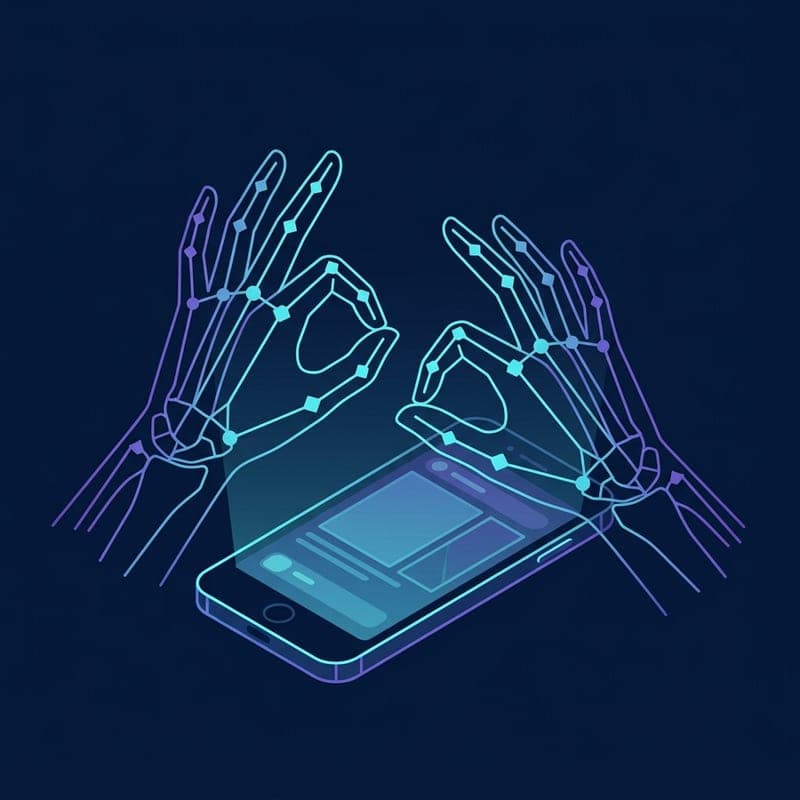
The most consequential design decision in SL2T is what the model never sees: raw video. An on-device MediaPipe Holistic model extracts geometric pose landmark coordinates — points on the signer's hands, arms, torso, head, and face — and only those coordinates travel to the server for translation. The original camera feed is discarded immediately, sidestepping the privacy exposure that would come with streaming video of users' faces and environments.
From those coordinate sequences, SL2T translates directly into text. That directness eliminates the gloss layer — intermediate sign-level annotations that most prior sign language translation systems depend on. Glosses impose an artificial vocabulary ceiling and cannot represent non-manual markers (facial expressions, mouthing, eyebrow raises) or spatial grammar constructions. Removing them lets translation quality scale with data volume rather than with the size of a hand-curated gloss lexicon — the same lesson that open-source document AI has demonstrated in adjacent multimodal domains.
Training Data and Multilingual Strategy
SL2T was trained on more than 100,000 hours of data spanning over 50 sign languages, with approximately one quarter of that corpus in ASL. The multilingual joint-training regime is deliberate: DeepMind reports that training across diverse languages, dialects, and proficiency levels causes the model to learn shared underlying structures, outperforming single-language models in their internal experiments. Dedicating the full data budget to a single target language is apparently the wrong call even when that language is the deployment target.
The team addressed distributional gaps that benchmarks typically ignore: explicit fairness engineering for the roughly 10% of signers who are left-handed, and separate optimisation for one-handed signing, which is common when a user is holding a smartphone. Streaming latency and hallucination suppression on non-signing inputs round out the practical deployment concerns baked into the training process.
Benchmark Results
On FLEURS-ASL (sd-test), the standard benchmark for ASL-to-English translation quality, SL2T achieves a zero-shot BLEURT score of 70 — which DeepMind describes as significantly higher than any previously reported score on that benchmark.
| Model | Benchmark | Score (BLEURT) | Evaluation condition |
|---|---|---|---|
| SL2T | FLEURS-ASL (sd-test) | 70 | Zero-shot |
| Prior best (unreported system) | FLEURS-ASL (sd-test) | < 70 (not disclosed) | Not specified |
The qualitative examples published alongside the benchmark score illustrate where the model still breaks down: rapid fingerspelling collapses ("prey" → "grey"), passive constructions and classifier depictions occasionally drop semantic content, and tense inference fails without surrounding context. Fingerspelling is used constantly for proper nouns and technical vocabulary, so developers integrating SL2T output into downstream pipelines should plan for post-processing or confidence gating on those patterns.
Governance and Deployment Access
SL2T 1.0 ships inside Gboard and Live Transcribe on Pixel 11 at no additional cost. The model was conceptualised by Sam Sepah, a Deaf Googler, and the release is accompanied by a joint impact report co-authored with the AI Sign Language Advisory Committee (AISLAC), comprising global Deaf organisations and subject-matter experts. DeepMind has committed to this participatory structure for all major sign language releases going forward.
No public API or SDK access has been announced. Developers building accessibility tools cannot yet call SL2T directly — the MediaPipe Holistic on-device tracker is the publicly accessible layer, while the translation model itself remains server-side and product-gated.
A major lab has now demonstrated a viable full-stack architecture for sign language translation — landmark extraction on-device, gloss-free sequence-to-text translation server-side — and shipped it at consumer scale. As multimodal accessibility becomes a regulatory and product expectation, this architecture will serve as a reference design in the same way that encoder-decoder spoken-language models did a decade ago.
Related Reading
Google DeepMind SL2T Brings Sign Language Dictation to Pixel 11
SL2T scores 70 BLEURT zero-shot on FLEURS-ASL, ships free in Gboard and Live Transcribe on Pixel 11 across 50+ sign languages.
Google DeepMind SL2T Brings Sign Language Translation to Pixel 11
SL2T scores 70 BLEURT zero-shot on FLEURS-ASL, ships in Gboard and Live Transcribe on Pixel 11, trained on 100,000+ hours across 50+ sign languages.
740M EmbeddingGemma 2 Maps Text, Image, Video and Audio
Google DeepMind's Apache 2.0 EmbeddingGemma 2 maps text, code, images, video and audio into one 768-dimension space, scaling from 270M to 740M parameters.