
Pipeline Architecture, Not Better Models, Drives 2026's Biggest AI Gains
In this article
The biggest AI productivity gains in production right now are not coming from better models—they are coming from better pipelines. Four independent deployments across different vendors, use cases, and engineering teams all arrived at the same structural conclusion within a 30-day window: decompose the monolith, specialise each component, and let asynchronous handoffs absorb the coordination cost. The aggregate results—33% cost reduction at AWS, 85% fewer open issues at Cloudflare, 56% containment improvement at Fanatics Betting and Gaming, and measurable idle-compute elimination via async Bedrock patterns—are not marginal tuning wins. They are the kind of step-change improvements that historically signal a phase transition, from experimental pattern to default practice.
The Shared Principle Behind Four Independent Results
Each deployment decomposed a task that a monolithic agent or pipeline previously handled end-to-end, then routed each subtask to the smallest, fastest component capable of handling it. The convergence on this principle across four unrelated teams is what makes the timing meaningful.
AWS split RAG into two sequential calls: a cheap Claude Haiku compression call strips irrelevant chunks before an expensive Claude Sonnet call ever sees them. The result is an 8.6× reduction in tokens reaching the primary model and a 33% cost reduction, with composite quality holding at 97.5% of baseline and hallucination rate dropping 7 percentage points—structurally, because the frontier model has less irrelevant text to confabulate over.
Cloudflare decomposed bug triage into four bounded subagents—reproduction, diagnosis, verification, fix—each with its own sandboxed execution context, passing state through an auditable report.md file. The human approval gate is the final state in a label-driven machine, not a safety afterthought bolted on afterward. The 85% issue reduction followed. This mirrors the principle described in four agent control layers with no shared contract, where distributing responsibility without coupling proves critical as workflows scale.
Fanatics Betting and Gaming built a supervisor agent on Claude Sonnet that delegates to specialists: a Nova 2 Lite classifier for responsible gaming detection, MCP servers for account queries, and a custom dual-search RAG pipeline for jurisdiction-specific retrieval. The 56% containment improvement and 53% resolution improvement arrived within the first two months. The engineering principle FBG made explicit—reserve large models for open-ended reasoning, use the smallest model that meets accuracy requirements for well-defined classification—is the same economic logic that drives the AWS compression pattern.
AWS's async Bedrock patterns address the decomposition principle at the infrastructure layer: when an agent reasons, a blocking Lambda caller pays for the wait. Releasing the caller via task-token callbacks means paying only for the dispatch—4.8 seconds in the documented test run versus 19.6 seconds of wall time. The orchestration pattern determines the cost profile independently of what the model does, a dynamic any team running agentic pipelines in production will encounter quickly.
What the Numbers Reveal About Where Leverage Lives
| Deployment | Decomposition applied | Primary metric | Result | Model changed? |
|---|---|---|---|---|
| AWS RAG compression | Two-call pipeline: small model filters, large model answers | Cost per query | −33% | No |
| Cloudflare issue triage | Four subagents, one task each, file-based state handoff | Open GitHub issues | −85% | No |
| Fanatics customer support | Supervisor + specialists + pre-processing safety layers | Containment rate gap | −56% | No |
| AWS async AgentCore | Caller releases compute during agent reasoning via callbacks | Lambda idle billing | Eliminated during wait | No |
The rightmost column is the argument in a single word, repeated four times. None of these teams waited for a better model. They restructured how existing models were called, composed, and coordinated.
What This Means for Engineering Investment—and Where the Argument Breaks
The implication is direct: systems architecture, evaluation infrastructure, and orchestration tooling now produce returns that model fine-tuning and prompt engineering alone cannot match at scale. Cloudflare's extraction of its triage workflow into the open-source Flue framework signals that the architectural patterns themselves are becoming reusable infrastructure. FBG's standing policy to exhaust prompt optimisation before migrating between models points in the same direction—the interface matters more than what sits behind it.
The strongest counterargument is that decomposition only works because today's frontier models are already reliable enough to serve as components. If model capability plateaus or regresses at a subtask, the whole pipeline degrades, and there is no architectural fix for a broken classifier or a hallucinating compression step. That is a real constraint. But it cuts against the counterargument rather than for it: model quality and architectural investment are complements, not substitutes. Right now the marginal return on architectural work is dramatically higher because model quality is already sufficient for most production subtasks—a distinction that matters when deciding where engineering time should flow at the frontier capability verification layer.
For this argument to be wrong, you would need a class of production workloads where decomposition consistently degrades quality faster than it reduces cost, and where that failure class is large enough to redirect engineering investment back toward monolithic pipelines and model scaling. None of the four deployments documented this month found that boundary.
Frequently asked questions
How much did AWS's two-call RAG compression pattern actually reduce costs?
AWS's pattern—routing retrieved chunks through Claude Haiku before Claude Sonnet—achieved a 33% cost reduction and an 8.6× reduction in tokens reaching the primary model. Composite quality held at 97.5% of baseline, and hallucination rate dropped 7 percentage points, because the frontier model received less irrelevant text to confabulate over.
How did Cloudflare reduce Astro's open GitHub issues by 85%?
Cloudflare decomposed bug triage into four sequential subagents—reproduction, diagnosis, verification, and fix—each with a sandboxed execution context. State passes between agents via an auditable report.md file, and a pull request is only opened after the original reporter confirms the fix. The full workflow runs inside GitHub Actions using issue labels as state transitions.
What results did Fanatics Betting and Gaming achieve with its multi-agent support system?
FBG improved containment rate by approximately 56% and resolution rate by approximately 53% within the first two months. The system routes inbound messages through a Claude Sonnet supervisor that delegates to a Nova 2 Lite responsible gaming classifier, MCP servers for account queries, and a custom dual-search RAG pipeline for jurisdiction-specific retrieval.
Why does the AWS async Bedrock pattern reduce Lambda costs?
A Lambda function blocking on a synchronous agent call pays for compute throughout the agent's entire reasoning cycle. Using task-token callbacks, the dispatcher Lambda returns in seconds—4.8 seconds in the documented test run—while the Step Functions execution pauses without billing any Lambda compute for the remaining ~14.8 seconds of agent processing.
Did any of these deployments require switching to a newer or larger model?
No. All four deployments achieved their gains using existing models. The AWS RAG compression pattern, Cloudflare's triage agents, FBG's supervisor-plus-specialist stack, and the async Bedrock patterns all restructured how models were called and coordinated rather than upgrading the underlying models.
What is the strongest argument against pipeline decomposition as the primary lever?
Decomposition only works if each component model is reliable enough for its subtask. If a classifier or compression step fails, the whole pipeline degrades and no architectural fix compensates for a broken model. However, this makes model quality and architectural investment complements rather than substitutes—and the current marginal return on architectural work is higher precisely because model quality is already sufficient for most production subtasks.
Related Reading

Production AI Fails on Architecture, Not Model Intelligence
Enterprise AI deployments stall because the harness breaks, not the model. Three failure modes prove why domain-specific architecture beats scaling.
Uber Eats Cuts Search Latency 50% With Pipeline Rewrites, Not New Models
Uber reports a 50% cut in Uber Eats search latency by redesigning retrieval, hydration, ranking, and ad-serving — no model changes required.
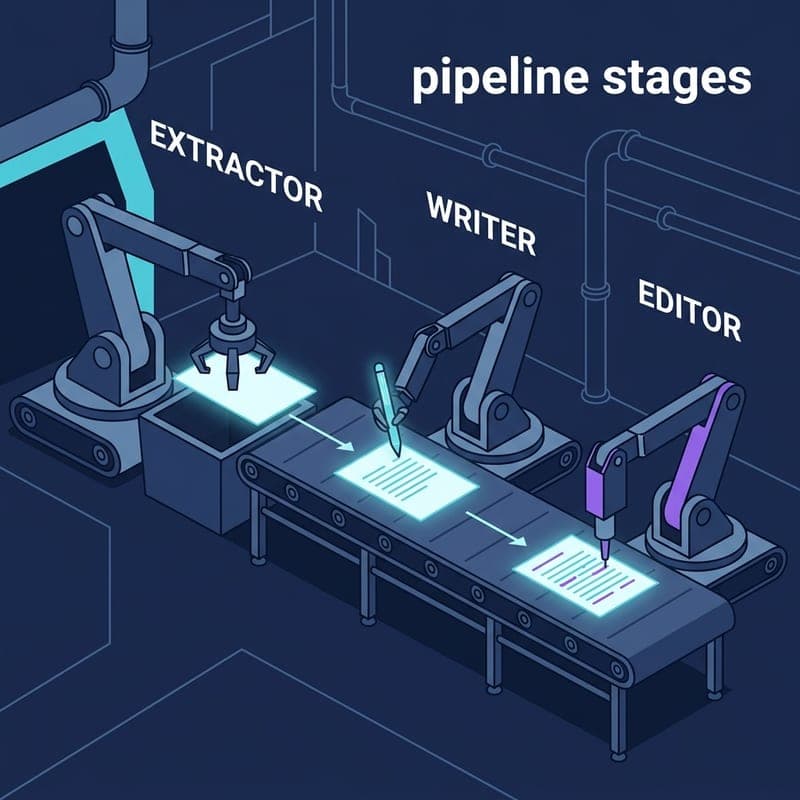
Build a Multi-Agent Sequential Pipeline with Semantic Kernel
Wire three specialised agents into an ordered pipeline using Semantic Kernel's SequentialOrchestration and InProcessRuntime — no glue code required.