
Event-Driven Architecture for Agentic AI: The Architect's Guide
In this article
- What Makes Agentic AI Architecturally Distinct
- Where Agentic AI Is Delivering Value Today
- Key Requirements for Production Agentic AI
- Openness and Interoperability
- Real-Time Trigger and Enrichment
- Unified Cross-Domain Intelligence
- Modular, Swappable Components
- Elastic Scale for Heterogeneous Workloads
- Zero-Trust Security and Auditability
- Robustness for Mission-Critical Use
- Why Event-Driven Architecture Fits
- Loose Coupling
- Fault Isolation and Horizontal Scale
- Event Cascades and Workflow Composition
- Reference Architecture
- Layer 1: Agents
- Layer 2: Trigger Gateways
- Layer 3: Event Mesh
- Layer 4: Orchestrator and Human Review
- Layer 5: Enterprise Integration
- Layer 6: Wide Connectivity
- Layer 7: Governance and Observability
- EDA vs. Synchronous Integration for Agentic AI
- What to Build First
- Conclusion
Agentic AI systems — autonomous, goal-directed agents that plan, act, and coordinate across distributed tools and services — are moving from research prototypes to production infrastructure. The same shift happened with microservices a decade ago, and it created the same set of hard problems: how do you scale hundreds of independently deployed components? How do you prevent a failure in one from cascading into the rest? How do you govern what they do?
Event-driven architecture (EDA) solved those problems for microservices. This guide makes the case that it is the right foundation for agentic AI too — and explains how to structure a system around it.
What Makes Agentic AI Architecturally Distinct
Traditional AI integrations are stateless and reactive: a request comes in, a model responds, the interaction ends. Agentic AI is different in kind. These systems are:
- Long-running — a single task may span minutes or hours, involving dozens of sub-tasks across external APIs, databases, and other agents
- Context-aware — agents accumulate and reason over state across multiple steps, not just the current input
- Autonomous — agents initiate actions, not just respond to them; they can loop, backtrack, and delegate without human prompting
- Collaborative — complex goals are broken down and distributed across specialised agents that need to coordinate without tight coupling
The infrastructure challenge is not making a single agent smarter. It is orchestrating networks of agents reliably, at scale, without building a coordination bottleneck in the middle.
Where Agentic AI Is Delivering Value Today
- Customer service — agents resolving support tickets end-to-end, integrating CRM history, billing records, and escalation rules without human mediation
- Financial analysis — continuous market data ingestion, synthesis, and recommendation generation across multiple data streams
- Real-time operational intelligence — natural language interfaces over live operational systems (order management, inventory, logistics) with anomaly detection and root-cause reasoning
- Employee onboarding — hiring events trigger coordinated multi-agent workflows spanning IT provisioning, payroll setup, and facilities access, eliminating manual checklists
- Knowledge management — enterprise knowledge platforms that access, reconcile, and synthesise information across organisational silos on demand
Key Requirements for Production Agentic AI
Before choosing an architectural pattern, it helps to enumerate what the infrastructure must actually deliver.
Openness and Interoperability
As agent networks grow, standardisation becomes critical. Two protocols have emerged as the primary interoperability layer:
| Protocol | Origin | What It Solves | Layer |
|---|---|---|---|
| Agent2Agent (A2A) | Standardises how agents from different vendors and frameworks communicate with each other — task delegation, status reporting, capability discovery | Agent ↔ Agent | |
| Model Context Protocol (MCP) | Anthropic | Gives agents a structured interface to call tools, APIs, and data sources — bridging agent reasoning to OpenAPI-defined services | Agent ↔ Tool/API |
These are not competing standards. A2A handles coordination between agents; MCP handles how each agent reaches into the world. A complete agentic system benefits from both.
- Cross-vendor agent discovery
- Task delegation & status
- Capability negotiation
- Multi-framework interop
- Structured tool invocation
- OpenAPI bridge
- Context & resource access
- Capability exposure to LLMs
Real-Time Trigger and Enrichment
Agents must respond to state changes as they occur. Real-time data serves three distinct roles:
- Triggering — an external event (a sensor reading, a record change, a user action) initiates an agent workflow
- Enriching — streaming data continuously updates vector databases and knowledge stores, so RAG queries return current results rather than stale snapshots
- Accelerating — up-to-date context allows agents to act decisively without requiring a human to fill in gaps
A system where agents can only poll for new information is not truly agentic — it is just batch processing with an LLM in the loop.
Unified Cross-Domain Intelligence
Agentic tasks rarely stay within a single system boundary. Resolving a supply chain disruption might require access to logistics data, maintenance records, weather feeds, supplier APIs, and internal CRM history simultaneously. Agents need read and write access across all of these without each access path being a custom point-to-point integration.
Equally important: the outputs of agents must be distributable. If one agent produces a mitigation plan, multiple downstream teams — operations, communications, staffing — may need to act on it immediately. Siloing the result defeats the purpose.
Modular, Swappable Components
The AI ecosystem is evolving rapidly. Architectural choices made today need to survive framework changes, new LLM releases, and protocol upgrades. The only way to achieve this is to enforce loose coupling between:
- Memory and retrieval services
- Planning and reasoning layers
- Tool and API connectors
- Output processors and notification channels
Each component should be independently replaceable. When a better embedding model ships, you should be able to swap it in without touching the planner. When a new agent framework emerges, teams should be able to adopt it without rebuilding the message routing layer.
Elastic Scale for Heterogeneous Workloads
Agentic systems run workloads with very different profiles simultaneously:
- Short-lived stateless agents — execute a single tool call and terminate
- Long-running stateful agents — maintain context across extended workflows, potentially resuming after interruption
Infrastructure must handle both without over-provisioning for the worst case. It must also coordinate agents operating across geographic regions while maintaining state consistency for workflows that span them.
Zero-Trust Security and Auditability
Autonomous agents making decisions at scale require stricter governance than traditional software, not looser. Every agent action must be:
- Authenticated and authorised — agents should operate under the principle of least privilege; a customer-facing agent should not have write access to financial systems
- Traceable — decision chains must be reconstructable: which agent acted, on what data, following what reasoning
- Auditable — data lineage must support regulatory compliance; who triggered a workflow and why must be answerable from logs
The zero-trust security model — verify every request, never assume trust from network position — must extend to agent-to-agent communication, not just human-to-system interactions.
Robustness for Mission-Critical Use
As enterprises entrust agents with higher-stakes decisions, failure handling moves from a nice-to-have to a hard requirement:
- Retry logic for transient failures
- Dead-letter queues for messages that cannot be processed
- Fallback agents with conservative default behaviours when primary agents are unavailable
- Human escalation paths for decisions outside an agent's confidence threshold
Traditional deterministic logs are insufficient for agentic observability. Because agent behaviour is probabilistic and context-dependent, observability must capture why a decision was made — the reasoning path, the data inputs, the confidence levels — not just that it was made.
Why Event-Driven Architecture Fits
EDA replaces synchronous request/reply communication with asynchronous message passing through a broker. This seemingly simple shift has profound architectural consequences for agentic systems.
Loose Coupling
In a synchronous architecture, every agent that wants to trigger another must know its address, call its API, and wait for a response. The dependency graph becomes a web of direct connections. Adding a new agent means updating every caller. Changing an agent's interface means coordinating across all consumers.
In EDA, agents communicate by publishing events to named topics. Other agents subscribe to the topics they care about. The publisher does not know or care who is listening. The subscriber does not know or care who published.
Practical consequences:
- A transaction completion event can trigger a fraud detection agent, an audit log agent, and a customer notification agent — all simultaneously, none of them aware of each other
- New agents can subscribe to existing event streams without any changes to existing code
- Teams can build and deploy their agents independently, on their own schedules
As agents become more autonomous and the number of agents grows, this independence becomes the difference between a manageable system and an unmaintainable one.
Fault Isolation and Horizontal Scale
Event brokers act as buffers between producers and consumers. When load spikes, events queue rather than timing out. When an agent instance fails, its pending events stay in the queue and are picked up when it recovers — or routed to another instance. Other agents in the system are unaffected.
Scaling a particular agent type is simply a matter of adding more consumer instances reading from the same queue. There are no topology changes, no reconfiguration of upstream systems.
An event mesh extends this across deployment environments. Agents running in different clouds, on-premises data centres, or edge nodes all connect to the same logical mesh. Events flow to wherever they are needed, with routing handled transparently by the infrastructure. Location becomes an operational detail, not an architectural constraint.
Event Cascades and Workflow Composition
EDA enables workflows that are composed rather than prescribed. Instead of a central orchestrator that knows every step in advance, each agent handles its task and emits an event when done. Downstream agents respond to those events, creating chains of activity that can branch, merge, and adapt to conditions dynamically.
A concrete example:
billing.anomaly.detected event with full payloadanomaly.summary.readyRich event metadata — priority fields, origin tags, content-type headers — allows agents to subscribe selectively and adjust behaviour based on context without requiring a central controller to route messages.
Reference Architecture
A production-grade event-driven agentic system has seven distinct layers. Each is independently scalable and replaceable.
Layer 1: Agents
Each agent is a single-purpose unit. A language understanding agent parses intent. A retrieval agent fetches context. A planner agent sequences sub-tasks. An executor agent calls APIs. This decomposition mirrors the microservices principle: small scope, clear interface, independent lifecycle.
Agents subscribe to relevant event topics on the mesh. When they complete their work, they publish result events. They don't call each other directly.
Layer 2: Trigger Gateways
The gateway layer normalises the many ways a workflow can start. A chatbot submission, a Salesforce opportunity stage change, a temperature threshold breach from an IoT device, and a scheduled batch job all produce different data in different formats. Gateways absorb this heterogeneity and emit standardised event payloads that agents can reason over without knowing anything about the originating source.
Layer 3: Event Mesh
The event mesh is the connective tissue of the architecture. Unlike a single central broker, a mesh is a network of brokers that spans all deployment environments. Events flow between clouds, data centres, and edge nodes transparently. The mesh handles:
- Topic-based routing — events reach only the consumers that subscribed
- Buffering — events persist through agent downtime; no messages are lost
- Dead-letter queues — unprocessable messages are captured for review rather than silently dropped
- Observability — every event can be traced end-to-end across the mesh
Layer 4: Orchestrator and Human Review
The orchestrator breaks high-level goals into concrete tasks and dispatches them to capable agents. It can operate prescriptively (following a defined workflow) or dynamically (routing based on agent availability and task outcomes).
Human-in-the-loop is a first-class concern, not an afterthought. When an agent escalates a decision — because it falls outside a confidence threshold, requires authorisation, or has regulatory implications — the escalation is published as an event. A human receives it through a review interface, acts, and submits a decision event that the orchestrator picks up and uses to continue the workflow. The rest of the system keeps running while the review is pending.
Layer 5: Enterprise Integration
Agents are most valuable when they can read from and write to the systems that run the business. ERP platforms hold operational records. CRM systems hold customer context. Public APIs expose external data. IoT sensor networks provide real-world telemetry. The event mesh handles the protocol and data format translation between these systems and the agents that consume them.
Layer 6: Wide Connectivity
Deployment locations are an operational reality, not an architectural concern. Some agents run at the edge to minimise latency or keep sensitive data local. Others run in the cloud for scale. The architecture is consistent across containers, serverless functions, and VMs. The event mesh routes traffic appropriately regardless of where any given agent is deployed.
Layer 7: Governance and Observability
Agent deployments follow CI/CD pipelines with rollback capabilities. Access is policy-controlled: agents operate under least-privilege principles, and policy changes take effect without redeployment. Decision logs capture not just what happened but why — the data inputs, the reasoning steps, the agent version that produced the output.
Metrics track success rates, latency distributions, and decision quality over time. This is how you detect drift, identify bottlenecks, and demonstrate compliance.
EDA vs. Synchronous Integration for Agentic AI
| Dimension | Synchronous (REST/gRPC) | Event-Driven (EDA) |
|---|---|---|
| Coupling | Tight — caller must know address, schema, and availability of callee | Loose — publisher and subscriber are unaware of each other |
| Failure handling | Caller blocks or times out; cascading failures if a dependency is down | Messages queue; agent recovers and processes backlog; rest of system unaffected |
| Scaling | Each new consumer requires a new integration point on the producer | Add consumer instances to the queue; no producer changes |
| Adding agents | Must modify existing agents to call new ones | New agent subscribes to existing topics; no changes anywhere |
| Fan-out | Producer must call each consumer sequentially or manage parallel threads | Single event publish triggers all subscribers simultaneously |
| Long-running workflows | Requires persistent connections or polling; complex state management | State held in events; workflow resumes naturally when agents become available |
| Observability | Each integration point requires custom tracing instrumentation | All events pass through the mesh; end-to-end tracing is structural |
| Geographic distribution | Latency and availability vary across regions; complex failover logic | Event mesh routes transparently; location is an operational detail |
What to Build First
Architectural discussions are most useful when they lead to concrete decisions. A practical sequence:
-
Map your event surface — identify the state changes across your enterprise that agents could act on: order status changes, sensor readings, CRM updates, support ticket creates. This becomes your topic catalog.
-
Pilot one multi-agent workflow end-to-end — pick a business-critical scenario where the current process is slow or brittle. Implement it with two or three agents connected via an event broker. The goal is to validate the integration pattern before committing to infrastructure.
-
Define governance policies before scaling — agent trust boundaries, authorisation scopes, escalation thresholds, and audit logging requirements are much easier to establish before you have fifty agents than after. Write these as code (policy-as-code) so they can be version-controlled and reviewed.
-
Instrument for reasoning, not just outcomes — standard application monitoring tracks errors and latency. Agentic observability requires capturing decision context: what data was available, what options were considered, what rationale drove the final action. Design your logging schema to support this from the start.
-
Measure business impact — accuracy rates and uptime SLAs are internal metrics. The questions that matter are: how much faster is this workflow? What decisions that previously required human time are now automated? What error rate are agents introducing compared to the previous process?
Conclusion
The analogy between agentic AI and microservices is not superficial. Both involve large numbers of small, specialised, independently deployed components that need to coordinate reliably at scale. The architectural patterns that made microservices manageable — loose coupling, asynchronous messaging, event-driven coordination, fault isolation through queuing — apply directly to agent networks.
EDA is not the only way to build agentic systems. For simple, two-agent workflows in a controlled environment, synchronous calls are adequate. But as the number of agents grows, as workflows span more systems, as availability requirements increase, the structural advantages of event-driven architecture compound. The systems that will handle genuinely complex, mission-critical agentic workloads will be event-driven by necessity.
The architectural choices made now — before agent networks reach production scale — determine how expensive it is to operate, extend, and govern them later. Starting with EDA principles means the infrastructure can absorb new agents, new frameworks, and new requirements without being rebuilt.
Frequently asked questions
Why is event-driven architecture a better fit for agentic AI than synchronous REST APIs?
Synchronous APIs create tight coupling — every agent depends on the availability and response time of every other agent it calls. EDA replaces this with asynchronous messaging through a broker, so agents operate independently, failures are isolated, and new agents can be added without modifying existing ones.
What is the difference between A2A and MCP protocols in agentic systems?
Agent2Agent (A2A) is Google's protocol for standardising cross-vendor agent-to-agent communication, letting agents from different frameworks or vendors interoperate. Model Context Protocol (MCP) is Anthropic's standard for giving agents structured access to tools and APIs. They are complementary: A2A handles agent coordination, MCP handles tool access.
What is an event mesh and how does it differ from a single message broker?
A single message broker is a central hub. An event mesh is a distributed network of brokers that spans cloud, on-premises, and edge environments, allowing events to flow seamlessly across all of them. Agents can operate close to their data sources while still participating in the broader system.
How does human-in-the-loop work in an event-driven agentic system?
Human review steps are modelled as events too. When an agent reaches a decision that requires validation or escalation, it publishes an event to a manual decision queue. A human reviews and approves or rejects via a gateway, which emits a response event that resumes the workflow. The rest of the system continues processing unrelated tasks while the review is pending.
Related Guides
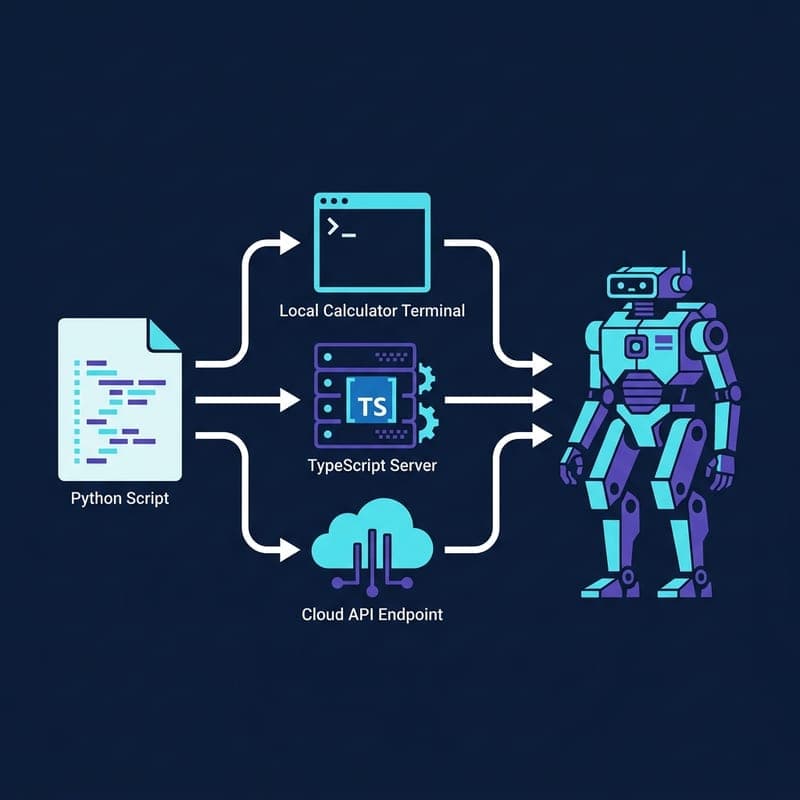
Build a Multi-Tool Claude Agent with MCP Servers in Python
Wire Claude to a local calculator, Brave search MCP server, and Anthropic-hosted tools in one extensible Python agent loop.
Build an Agentic RAG System with smolagents and ChromaDB
Use smolagents CodeAgent to run multi-step retrieval over a ChromaDB vector store, letting the agent plan its own search strategy.
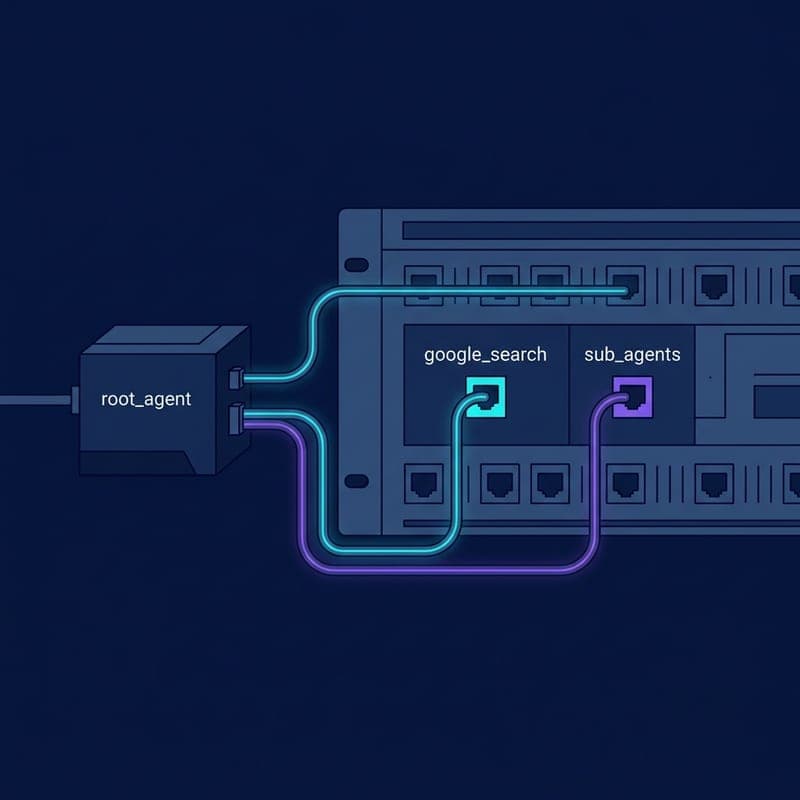
Build a Grounded Search Agent with Google ADK
Build a web-grounded AI agent with Google ADK's built-in google_search tool, from pip install to a grounded answer in the ADK dev UI.