Top 5 Small Language Models for Agentic Tool Calling
In this article
Introduction
At the core of an Agentic AI workflow is the reliability of tool-calling. A model must successfully triage functions, format JSON arrays for arguments, and accurately fold downstream function outputs back into extended reasoning sequences. Large frontier intelligence (e.g., ChatGPT, Claude) achieves this effortlessly, however they impose a massive dependency matrix of latency, financial overhead, and remote API access.
Small Language Models (SLMs) have significantly closed the accuracy gap. More importantly, they run localized operations without invoking serverless functions or burning network transit budgets.
In this guide, we analyze 5 high-impact open-weight models prioritizing tool calling formats on Hugging Face.
1. SmolLM3-3B
- Release Date: July 8, 2025
- Developer: Hugging Face
| Technical Aspect | Details |
|---|---|
| Parameters | 3B |
| Architecture | Decoder-only transformer (GQA + NoPE, 3:1 ratio) |
| Context Length | 64K native; up to 128K with YaRN extrapolation |
| Training Tokens | 11.2T |
| Reasoning Mode | Dual-mode (thinking / no-think toggle) |
| Tool Calling | Yes: JSON/XML (xml_tools) and Python (python_tools) |
SmolLM3-3B remains the gold standard for small-parameter boundaries. By optimizing Grouped Query Attention (GQA) against No Positional Embeddings (NoPE), the architecture retains an immense 64k token context window natively. Hugging Face orchestrated an Anchored Preference Optimization (APO) mid-training phase allowing the model to switch natively between XML blob tools and Python function parsing. This makes it heavily adaptable inside LangChain or direct local RAG nodes mapping Python tools.
2. Qwen3-4B-Instruct-2507
- Release Date: August 6, 2025
- Developer: Alibaba (Qwen Team)
| Technical Aspect | Details |
|---|---|
| Parameters | 4.0B (3.6B non-embedding) |
| Architecture | Causal LM, 36 layers, GQA (32 Q heads / 8 KV heads) |
| Context Length | 262,144 tokens (native) |
| Reasoning Mode | Non-thinking only (no <think> blocks) |
| Tool Calling | Yes: native, via Qwen-Agent / MCP |
The non-thinking trajectory of the Qwen3-4B-Instruct-2507 release maximizes raw response latency for agentic orchestration. Qwen stripped out explicit chain-of-thought blocks directly favoring extreme instruction adherence. Operating atop 36 distinct transformer layers, it natively supports Alibaba's Qwen-Agent execution framework and boasts immense compatibility with local Model Context Protocol (MCP) server integration files.
3. Phi-3-mini-4k-instruct
- Release Date: April 2024
- Developer: Microsoft
| Technical Aspect | Details |
|---|---|
| Parameters | 3.8B |
| Context Length | 4K native |
| Specialty | General strict logic processing and Math |
| License | MIT |
Phi-3-mini-4k-instruct maintains relevance given its extreme compute efficiency. As one of Microsoft's foundational "small but smart" releases, it executes directly on-device hardware (smartphones, IoT arrays). Validated heavily through Direct Preference Optimization (DPO), it remains one of the cleanest open-source starting points for commercial tool-calling adaptations due strictly to its MIT permissive software license.
4. Gemma-4-E2B-it
- Release Date: 2026
- Developer: Google
| Technical Aspect | Details |
|---|---|
| Parameters | 4B |
| Integration | Code Sandbox Environment native |
| Tool Calling | Direct Python Evaluation outputs |
Google's updated iteration heavily utilizes isolated environment executions to parse tools directly as executable Python code.
5. Llama-3-2B-Instruct
- Developer: Meta
Rounding out the spectrum is Meta's deeply optimized instruction-variant of the Llama line. The baseline tool calling provides extensive structured generation templates specifically suited for JSON extraction and internal API piping over mobile silicon.
Conclusion
Local language models enable unparalleled privacy and extreme cost savings for Agentic orchestration. Depending on the size of your orchestration scripts, evaluating SmolLM3 vs Qwen3 largely depends on if your stack favors python_tools parsing natively, or if you plan on deploying custom MCP connectors via local Node arrays. Consider diving into our Hardware ROI Calculator to size up your local deployment needs.
Related Guides
The Best Small Language Models Available on Hugging Face
A comprehensive breakdown of the most capable sub-8B parameter local language models currently dominating the Hugging Face hub.
Build a Multi-Tool Claude Agent with MCP Servers in Python
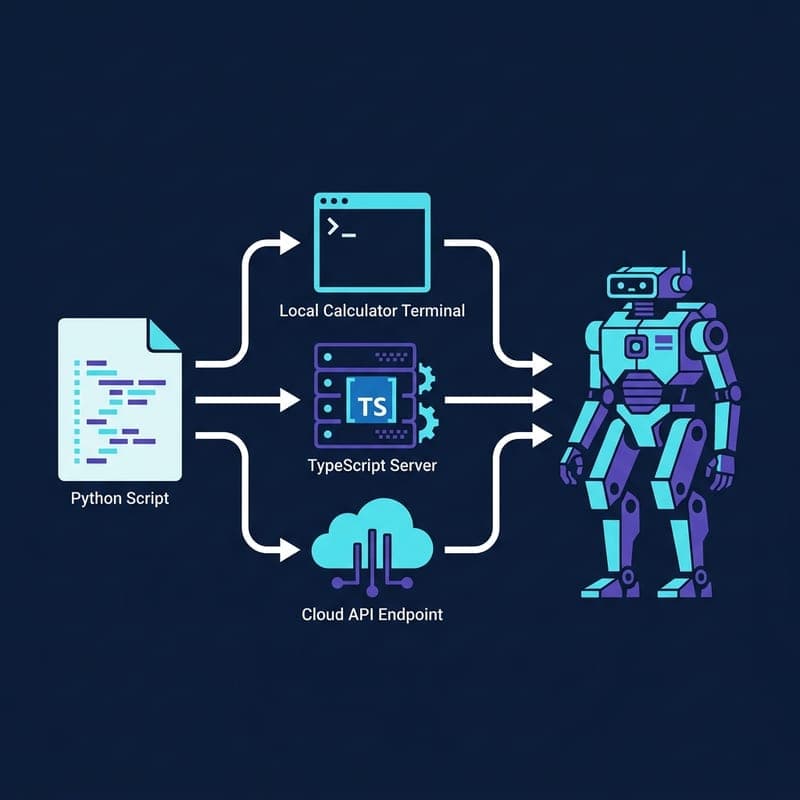
Wire Claude to a local calculator, Brave search MCP server, and Anthropic-hosted tools in one extensible Python agent loop.

Build an Agentic RAG System with smolagents and ChromaDB
Use smolagents CodeAgent to run multi-step retrieval over a ChromaDB vector store, letting the agent plan its own search strategy.